Category Archives: Blogs

The Vortex Swim | 9.3.19

The Vortex Swim is a 300 nautical mile swim from Hawaii to San Francisco done by Ben Lecomte and his team. Ben Lecomte is a long-distance swimmer from France, who has been seen to be the first man to swim the Atlantic Ocean. The past two summers he has tried to swim through the Pacific Ocean, but last summer he had to stop in Hawaii because the swim took longer than they had planned. Instead of trying again, Ben and his team decided to swim from Hawaii to San Francisco through the Pacific Trash Vortex, which holds millions of microplastics that affect marine life in the Pacific Ocean. When most people think of plastic in the ocean, they envision these large pieces of plastic floating around. In reality, there are millions of tiny pieces of plastic rather than large pieces.

The microplastic which Ben and his team collected have been given to scientists to test and study. This swim brings to light the negative affect that plastic has on the environment. Looking at how much microplastic Ben Lecomte and his team picked up from the swim, has shown me how much the world needs to change if we want to protect the ocean and the organisms living in it. This swim has driven my curiosity on the direct impact the plastic has on the marine organisms and the future effects it may have. It is also interesting to see the affects of the swim on Ben, as he swims for 8 hours each day in cold salt water filled with all of this trash.

To get a sneak peak on Ben Lecomte’s journey, watch this video to learn more about his journey

If you want to learn more about the Vortex Swim, you can visit Ben Lecomte’s site that holds logs from each day in the water: https://benlecomte.com/#

Works Cited:
“4ocean Helping Advance Science in the Great Pacific Garbage Patch – The Vortex
     Swim.” 4Ocean, 22 July 2019, legacy.4ocean.com/blogs/blog/
     4ocean-helping-advance-science-in-the-great-pacific-garbage-patch. Accessed
     2 Sept. 2019.

Potts, Mary Anne. “This is what it’s like to swim through the Great Pacific
     Garbage Patch.” National Geographichttp://www.nationalgeographic.com/adventure/
     2019/08/great-pacific-garbage-patch-swim-science/. Accessed 2 Sept. 2019.

The Vortex Swim – Ben Lecomte | DE. Composed by Icebreaker, 2019. Youtube ,
     www.youtube.com/watch?v=UvlcFHfTn4c. Accessed 3 Sept. 2019.
A Plastic Ocean | 9.5.19

A Plastic Ocean is a documentary made by Craig Leeson that brings to light the amount of plastic that has filled our oceans and the affects of it. After discovering a large amount of plastic floating around in his search for blue whales, Leeson decided to travel to other countries that are known to have significant amounts of plastic around the area.

If you are interested in learning more about A Plastic Ocean, you should watch the documentary or visit their website which holds more information on their mission and goals.

To pique your interest in the documentary, you can watch the trailer first

After watching A Plastic Ocean, I am shocked at the amount of plastic that gets put back in the ocean and the repercussions of this. Although plastic is seen as a recyclable item, most of the time the plastic that we use ends up in the ocean. Over 8 million tonnes of plastic is put into the oceans and a large amount of this plastic is affecting not only marine life but all organisms. Because plastic does not degrade, it just breaks up into tiny pieces called microplastic that animals digest. It is fatal for animals to digest these microplastics because they fill up an organism’s stomach leaving no room for actual food which causes the animals to starve to death. Plastic does not only cause organisms to starve, but it also releases toxins and chemicals that can travel to vital organs. People may think that it doesn’t affect us, but we may be eating the organisms that have digested plastic and intake all of the chemicals that plastic has. This documentary has shown me that we need to be more conscious about what materials we use because if we don’t change the world will become a wasteland of plastic. It was surprising, but eye-opening, how barely any stores or restaurants have only packaging in plastic and how many chemicals can seep in our food from the plastic. Overall, this documentary has inspired me to be more aware of the amount of plastic we use and where it gets disposed of. I hope you decide to watch this documentary and be more environmentally conscious!

Works Cited:

“About the Award-Winning Documentary A Plastic Ocean.” Plastic Oceans,
     plasticoceans.org/about-a-plastic-ocean/. Accessed 4 Sept. 2019.

F.L.O.W. | 9.24.19

The documentary “F.L.O.W.: For Love of Water” brings light to the necessity of water and how many companies are profiting from water, while others are suffering from a lack of clean water. This water crisis is so bad that it is expected that there will be wars over fresh water because we are running out.

If you are interested in learning more, here is the trailer for FLOW

After watching FLOW, I am shocked at the amount of water is being used and how there is the possibility of us running out of it. It is crazy to think that more than two million people die each year from water born diseases because of unclean water that a majority of these people had to drink since it was the only water they had. There are over 208,000 people that are excluded from water. There are also so many bad substances, like harmful chemicals, that can cause cancer and can chemically castrate certain male species. Thee chemicals also cause for crops to need five to ten times more water to just get rid of the chemicals. In the last 10 years, 3 major companies have taken control and privatized water which forces people to pay for the water. This is what causes so many people to drink dirty, unhealthy water because they are unable to pay what these companies are forcing people to pay for water. Although water is a natural resource that is provided for us, companies are taking advantage of it by gaining money by selling water to people. Just like sky and the sun, water is a resource that shouldn’t be sold, especially since there is no substitute for clean fresh water. We should be protecting the water we have everywhere if we want to survive on the planet.

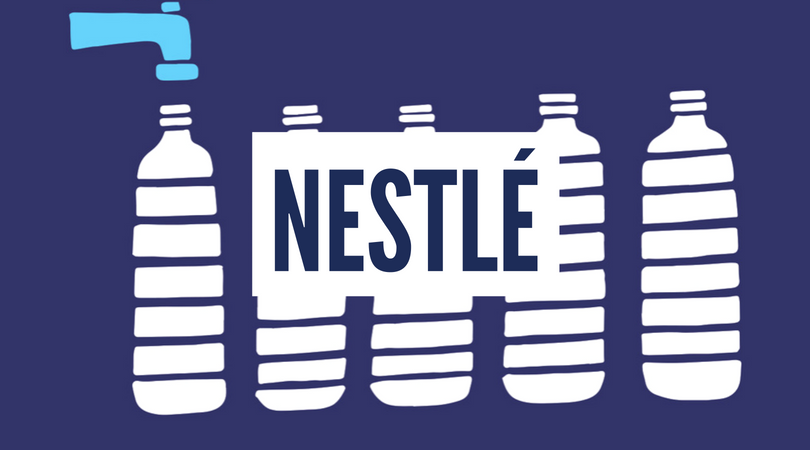
Here is a picture of showing one company, Nestle, producing water bottles that are causing a lot of problems to our environment.


Along with tap water, bottled water companies are also highly impactful to the community. Over 100 billion dollars is spent on bottled water a long per year. Not only do bottles water use plastic, which is harmful to the environment, but they also hurt the area that the companies are taking water from. One company, Nestle, was specifically pointed out in the documentary. In Michigan, Nestle making 1.8 million dollars a day, but paying nothing to take the water. Because of the 450 gallons per minute that Nestle was taking from the water supply in Michigan, people were running out of water and creating mud flats from where water used to be. Although everyone thinks that bottled water is cleaner than tap water, that is actually incorrect because bottled water is less regulated with tap since only one person manages regulation for bottled water companies.

Humans have become selfish by only taking from nature and not giving back. Help be the change to help provide for those who don’t have enough money to pay for the overpriced water. There are many foundations trying to make a difference, like Charity:Water that are building wells in Africa. It doesn’t make a huge contribution to make a change and help our environment.

To learn more about other current water issues the world is facing and some solutions you can visit this website.

Works Cited:
“Public Trust Solutions for the Great Lakes.” FLOW, flowforwater.org/.

oscopelabs. “FLOW – Official Theatrical Trailer – Oscilloscope Laboratories.” YouTube, YouTube, 29 July 2008, http://www.youtube.com/watch?v=LGd9D4J0lag.

Earth Science Week | 10.24.19

Every year during Earth science week, a photography contest is held to help people explore and appreciate Earth science. This year the photo contest focused on capturing someone in the community encountering and discovering more about Earth science.

Down below is the photo and caption that I submitted to the ESW contest:

People from all over come to visit Joshua Tree National Park in Southern California to hike, rock climb, camp, or simply explore the magnificent view that the park provides. The park allows people to discover more about geology and the specific species of trees known as the Yucca tree that span the entirety of the park.

Cracking Your Genetic Code | 11.22.19

This week in biology we started a very interesting unit: GENETICS! We started the unit off by watching a documentary called Cracking Your Genetic Code. This documentary prosed the questions: “how well do you know yourself?” And they don’t mean your physical appearance and your body, they mean what you are made of: genes. Genes are essential to life since all organisms contain different genes. Our genes code for everything in our body – hair, height, eyes, and even diseases. Diseases in someone can be inherited from our parents or there can be a mutation in a person’s genome. Genes are sequenced with a code made up of G (guanine), T (thymine), A (adenine), and C (cytosine). One change in a letter of a person’s genes can cause a mutation and diseases within a person.

To learn a little bit more of what the documentary is about, here is the trailer!

The documentary did a good job at demonstrating the pros and cons of genomics and the effect’s that genomics had on people’s lives. They provided many examples that supported and argued against seeing a person’s whole genome sequencing.

One example discussed sequencing a person’s genome from birth. There are many ethical debates about this, but the documentary displayed a case where twins that showed symptoms of cerebral palsy wished they had their genes sequenced when they were younger. After discovering they did not have cerebral palsy and taking a drug that helped with the symptoms they had seen, the two had their genes sequenced where they found another mutation and was properly treated. Although this was one scenario that would have benefited from early gene sequencing, a child’s life may be affected if their parents were to know the health risks that the child could have from a young age.

Of course gene sequencing comes with a moral dilemma. There are benefits to genomics as they can may find a disease and get proper treatment before the disease gets worse or it can allow people to plan for a future with a disease they may get. Genomics may also reassure someone that they are healthy or other risks that they need to be aware of so that they can stay healthy. On the other hand, gene sequencing can be a burden to know and people may start only being involved with others based on if their genetic codes are healthy.

Although there are many ethical dilemmas with genomics, doctors have started to sequence cancer cells to determine if there is a specific variant that is causing the cells to uncontrollably split. One example was a man that had skin cancer. He only had a few months to live, but after the sequence of genes that was causing uncontrollable cell division was determine, a drug that only targeted the gene mutation was developed and significantly helped the man’s health. Unfortunately cancer cels can evolve to resist drugs, even those specific to gene mutations, but sequencing genes in cancer may lead scientists one step closer to finding a combination of drugs that will kill off cancer.

Works Cited:
“Cracking Your Genetic Code.” PBS, Public Broadcasting Service, http://www.pbs.org/wgbh/nova/video/cracking-your-genetic-code/.

Youtube, Youtube, https://www.youtube.com/watch?v=UPzid88oSFc